
TL;DR: Dark spots on the face fade gradually when the treatment matches the cause and the skin is protected from the sun every day. In a 2024 survey of 409 Indian dermatologists published in the Journal of Dermatology Research, 59.2% named sun exposure as the most common cause of hyperpigmentation. Azelaic acid, kojic acid, glycolic acid, vitamin C and retinoids are common topical options. Hydroquinone and steroid combination creams belong under a dermatologist's direction. Without daily broad-spectrum sunscreen, treated spots tend to darken again and new ones form.
How do you remove dark spots on your face?
Removing dark spots on the face means fading excess pigment over months while stopping the sun from adding more. Hyperpigmentation is the general term for skin that looks darker than its surroundings, and a dark spot is one defined, flat patch of it. A broad patch of melasma and a single post-acne mark respond to different treatments at different speeds, so any routine starts with the cause.
A routine for flat spots follows five steps:
Identify the type of spot. Melasma, post-acne marks and sun spots have different triggers, so knowing which one you have decides what to use. Raised, rough or changing spots fall outside home care and need a dermatologist.
Wear broad-spectrum sunscreen every morning. Use SPF 30 or higher across the whole face, including on cloudy days. UV light keeps stimulating pigment cells, so every other step depends on this one.
Add one targeted ingredient at a time. Start with a single active such as azelaic acid or a gentle retinoid, and patch-test it first. Irritation is itself a trigger for new marks, so stacking several strong actives often backfires.
Allow several months. Fading happens as pigmented cells are replaced, which takes time. Over-the-counter fade creams usually need several weeks or months of regular use before a change shows.
See a dermatologist when home care stalls. Prescription creams, chemical peels and light-based treatments sit with a doctor, who can also rule out anything more serious. For anyone pregnant, breastfeeding or on regular medication, this is the first step rather than the last.
Treatment fades many dark spots, and daily sun protection is what keeps them faded. Some spots do not disappear completely, so the realistic goal is a lighter, less noticeable mark.
What causes dark spots on the face?
Dark spots on the face form when skin cells produce too much melanin, the pigment that gives skin its colour. Cleveland Clinic explains that damaged or unhealthy cells can overproduce melanin, which clumps and makes one area look darker. Its list of triggers includes sun damage, hormonal changes such as pregnancy, acne and other skin injuries, some medications, low vitamin B12 or folic acid, and thyroid or adrenal disorders.
Most flat dark spots on the face fall into three types:
Melasma. Melasma is hormone-linked facial pigmentation that usually appears in patches. It is more common in women and around pregnancy, and it tends to be the most stubborn type to fade.
Post-inflammatory hyperpigmentation. Post-inflammatory hyperpigmentation (PIH) is the dark mark left after skin is inflamed or injured, most often by acne, a cut, a burn or a harsh product. Research in Clinical, Cosmetic and Investigational Dermatology notes that PIH is more frequent, more intense and slower to fade in medium-to-deep skin tones (Fitzpatrick types III to VI). Picking or squeezing pimples raises the risk.
Sun spots. Sun spots, also called solar lentigines or age spots, are flat tan to dark brown patches built up over years of UV exposure. They are very common after 50, can appear earlier with heavy sun and, unlike freckles, do not fade on their own.
In a 2024 survey of 409 Indian dermatologists, 50.2% named melasma and 49.8% named post-inflammatory hyperpigmentation as the most common form of hyperpigmentation in their practice, according to the .
The same survey ranked hormonal changes (26.4%) and acne (14.4%) behind sun exposure as causes. These figures record what dermatologists in a convenience sample see in practice, not how common dark spots are. No published figure measures how many people in India have dark spots or melasma.
Which creams and serums help fade dark spots?
No single cream is the best dark spot remover for everyone; the right choice depends on what caused the spot and on your skin type. A tyrosinase inhibitor is an ingredient that blocks tyrosinase, the enzyme pigment cells use to make melanin. Many fading ingredients work this way, while others speed the shedding of pigmented cells or calm the inflammation that sets off pigment production.
| Ingredient | What it does | What to expect | Who guides its use |
|---|---|---|---|
| Hydroquinone | Reduces melanin production | Mayo Clinic says prescription hydroquinone may fade spots gradually over several months, with possible itching, redness, burning or dryness | A dermatologist, for a short supervised course |
| Tretinoin and other retinoids | Speed up skin cell turnover | Results take months, and retinoids make skin more sensitive to UV | A doctor for tretinoin; avoid all retinoids in pregnancy |
| Glycolic acid and kojic acid | Glycolic acid exfoliates; kojic acid reduces melanin production | Over-the-counter fade creams with either need several weeks or months of regular use | Self-selected, after a patch test |
| Azelaic acid | Often chosen for post-acne marks | Choose a product that states its strength on the label | Self-selected or prescribed |
| Vitamin C | Antioxidant support | Works best as a morning step under sunscreen; results depend on formulation | Self-selected |
Hydroquinone is the strongest of these and the most often misused. In the same 2024 survey, 45.5% of Indian dermatologists chose hydroquinone combinations as their preferred first-line treatment, which marks it as a dermatologist-directed medicine rather than a casual purchase. Used for months without supervision, hydroquinone can cause exogenous ochronosis, a blue-black darkening that is harder to treat than the original spots, according to a Blacklisted fact-check. Combination creams that add tretinoin and a steroid need the same supervision, and any product listing mercury (sometimes written as hydrargyri oxydum rubrum or cinnabaris) should be avoided.
For the vitamin C step, Skinspired stocks Cantabria Labs' Endocare Radiance serums; each product page lists its full formula.
Sun protection decides whether dark spots come back
Dark spots come back, and new ones form, mainly when skin is left unprotected. Treatments can clear some spots and lighten others, but sun and age spots tend to darken again on exposed skin. Mayo Clinic advises applying a broad-spectrum SPF 30 or higher 15 to 30 minutes before going out and reapplying every two hours, more often when sweating. Shade and a hat from late morning to mid-afternoon reduce the load further.
Sunscreen does not fade an existing dark spot by itself; it stops the spot from darkening and protects whatever a treatment achieves. Visible light adds a second layer for melasma and stubborn pigmentation. A US board-certified dermatologist's guide explains that even diligent use of untinted sunscreen can let pigmentation worsen, because it lacks the iron oxides that tint a formula and filter visible light. Treat daily SPF 30 as the baseline and a tinted, iron-oxide sunscreen as the extra step for pigmentation-prone skin.
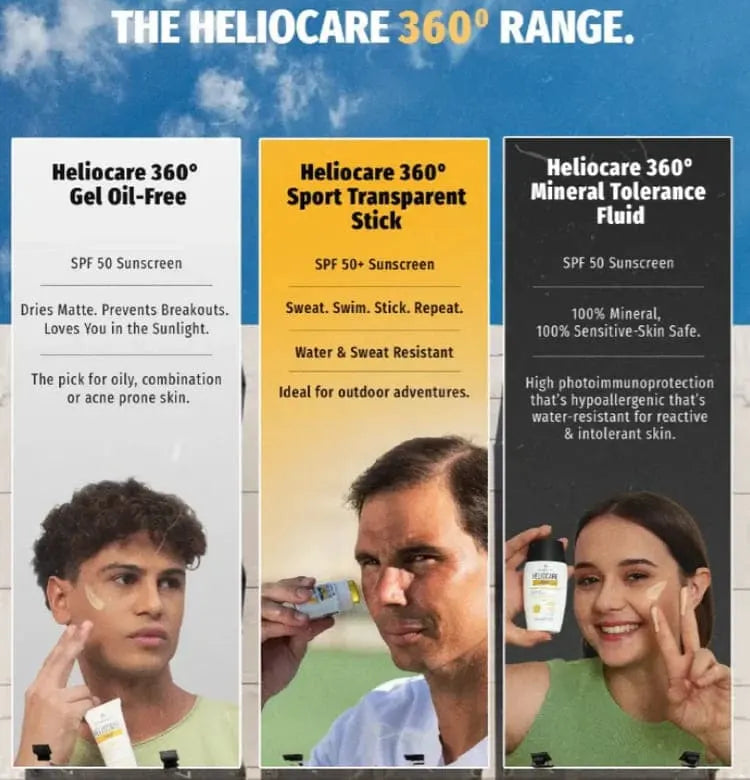
For pigmentation-prone skin, Skinspired stocks the Heliocare 360 Pigment Solution Fluid SPF 50+, which its product page describes as a tinted fluid formulated with iron oxides, zinc oxide, niacinamide, ellagic acid and Fernblock®+, with protection stated against UVA, UVB, infrared and visible light. For an untinted option, the Heliocare 360 Water Gel SPF 50+ is a hydrating gel formulated with ASPA-Fernblock®, and its page states protection against UVA, UVB, infrared and high-energy visible light. Both are sunscreens, built to protect skin from the radiation that triggers and darkens pigmentation.
How do Fernblock® and Fernblock®+ differ?
Fernblock® and Fernblock®+ are both Cantabria Labs extracts of the fern Polypodium leucotomos, and Fernblock®+ is the second generation. Cantabria Labs describes Fernblock®+ as a new-generation extract whose optimised extraction method enhances its activity.
- Fernblock®
- Cantabria Labs' patented, standardised extract of the Polypodium leucotomos fern and the core active ingredient of its Heliocare range.
What does Fernblock®+ add to the original extract?
Fernblock®+ begins with more of the compounds that do the work. Cantabria Labs reports higher concentrations of the main polyphenols behind the fern's antioxidant and photoprotective activity, including ferulic, caffeic, p-coumaric, vanillic and chlorogenic acid. The first two matter most: a review in the journal Life identifies ferulic and caffeic acids as the most potent antioxidants among the extract's phenolic compounds.
Visible light and infrared-A are where that extra antioxidant strength pays off in a pigmentation routine. The Life review notes that recent research indicates infrared and visible light can play an important role, alongside UV, in processes such as pigmentation and photoageing. Cantabria Labs says Fernblock®+ helps prevent collagen breakdown and neutralises free radicals generated by UV, visible light and infrared-A.
Repair is the third gain. Cantabria Labs notes that solar radiation damages cell DNA during exposure and for up to six hours afterwards, and says its Fernblock® technology limits that build-up and increases the capacity for repair. For Fernblock®+, Cantabria Labs reports DNA protection and repair, photoprotection and anti-ageing effects significantly greater than those of standard Fernblock®, in some measures up to eight times greater.
A further version, ASPA-Fernblock®, appears in the Heliocare 360 Advanced Gel SPF 50 and in the Water Gel.
The immune-protection evidence comes from the fern extract in general. In a study of 21 healthy volunteers, oral and topical Polypodium leucotomos extract both protected Langerhans cells, the immune cells of the skin, from solar radiation, and raised the UV dose needed to trigger sunburn and immediate pigment darkening. That extract was not identified as Fernblock®+, and the study measured protection from sun exposure rather than the fading of existing spots. Cantabria Labs pairs both extracts with UV filters, so choosing between Heliocare sunscreens comes down mostly to tint, texture and skin type.
When should a dermatologist check a dark spot?
A dermatologist should check any dark spot that is new, changing or unusual before you treat it at home. Mayo Clinic advises having a spot evaluated if it is black, growing, has an irregular border, shows an unusual mix of colours or bleeds, because some spots can look like skin cancer. Spots that appear suddenly, itch or tingle belong on the same list, and a doctor may take a biopsy to rule out lentigo maligna, a type of skin cancer that can resemble a sun spot. Raised dark spots also need assessment, since creams and serums are designed for flat discolouration.
What can a dermatologist offer for stubborn spots?
In-clinic options include chemical peels, cryotherapy and laser treatments. Mayo Clinic says laser and intense pulsed light treatments for age spots typically take two to three sessions; intense pulsed light (IPL) is a light-based treatment, not a laser. The same guidance lists scarring, infection and lightening or darkening of skin colour among possible peel side effects, and a slight risk of permanent scarring or discolouration from freezing. For medium-to-deep skin tones, that risk of colour change is the reason to choose a dermatologist experienced with skin like yours.
Sources
Hyperpigmentation Management Perspectives: A Nationwide Survey of Indian Dermatologists - Athenaeum Scientific Publishers (Journal of Dermatology Research (Galderma-affiliated authors), 2026-02-21)
12-Week, Single-Center Study of a Targeted Pigment-Correcting Dark Spot Treatment for Post-Inflammatory Hyperpigmentation and Solar Lentigines - PMC (SkinMedica – Allergan Aesthetics (AbbVie), with SGS Stephens Inc; published in Clinical, Cosmetic and Investigational Dermatology, 2023-09-27)
Is Hydroquinone Banned in India? Prescription Rule (2026) (Blacklisted (no clinical source cited))
Age spots (liver spots) - Symptoms and causes - Mayo Clinic (Mayo Clinic, 2025-05-03)
How to ACTUALLY Fix Dark Spots (Dermatologist No-BS Guide) - YouTube (Dr. Daniel Sugai, board-certified dermatologist (YouTube), 2026-02-28)
Fernblock® Technology | Cantabria Labs (Cantabria Labs (manufacturer; US site))
Clinical Applications of Polypodium leucotomos (Fernblock®): An Update - PMC (Rodríguez-Luna A et al.; Life (Basel), MDPI, 2023-07-05)
Introducing ASPA-Fernblock®: The next generation of sunscreen innovati
– Cantabria Labs (Cantabria Labs (UK site, HELIOCARE 360°))HELIOCARE 360° Supplements FAQs
– Cantabria Labs (Cantabria Labs (manufacturer; UK site))Topical or oral administration with an extract of Polypodium leucotomos prevents acute sunburn and psoralen-induced phototoxic reactions as well as depletion of Langerhans cells in human skin - PubMed (Peer-reviewed clinical study indexed on PubMed (PMID 9361129))
Age spots (liver spots) - Diagnosis and treatment - Mayo Clinic (Mayo Clinic, 2025-05-03)
Frequently asked questions about dark spots on the face
- Can dark spots on the face be removed permanently?
- Dark spots on the face can usually be faded, but no treatment guarantees they stay gone. Sun and age spots tend to persist and darken without sun protection, and new spots can form over time. Daily broad-spectrum sunscreen of SPF 30 or higher is what keeps faded dark spots from darkening again.
- How long do dark spots take to fade?
- Dark spots usually take months to fade. Medical News Today reports that in darker skin, hyperpigmentation usually fades within 6 to 12 months once its cause is removed, while deeper pigment can take years. Fading also depends on keeping the trigger, such as sun or acne, under control.
- How do I get rid of dark spots caused by pimples?
- Dark spots caused by pimples are post-inflammatory hyperpigmentation, and they can fade over time once the acne is under control. Avoid picking or squeezing pimples, wear sunscreen every day and consider azelaic acid. A dermatologist can treat the acne itself, which stops new post-acne dark spots from forming.
- Is hydroquinone safe for dark spots on the face?
- Hydroquinone can fade dark spots on the face, but it should be used only under a dermatologist's direction, for a short planned course. Long, unsupervised use can cause exogenous ochronosis, a blue-black darkening that is harder to treat than the original spots. Hydroquinone is also best avoided during pregnancy.
- Does sunscreen fade dark spots?
- Sunscreen does not fade existing dark spots by itself, but it stops them from darkening and protects the results of any treatment. A broad-spectrum SPF 30 or higher is the daily baseline. People with melasma or stubborn pigmentation often add a tinted sunscreen with iron oxides, which also filters visible light.
- Are dark spots on the face a sign of skin cancer?
- Most dark spots on the face are not skin cancer. Post-inflammatory marks and sun spots have no cancer potential, according to research in Clinical, Cosmetic and Investigational Dermatology. Any dark spot that is black, growing, irregular, multi-coloured, bleeding or sudden in appearance should still be checked by a dermatologist before treatment.
Choose a daily sunscreen with Skinspired's help
Daily sun protection is the one step every dark spot routine shares, and the sunscreen you will actually wear each morning is the one with a texture and tint you like. If you are unsure which Heliocare sunscreen suits your skin, send your question to the Skinspired team. For a spot that is changing, see a dermatologist first.